Adventures in Library Land
  • Adventures
  • About
  • Contact

The Mansueto Library and the Death of Serendipity...  or Ahead to the Past

8/2/2014

2 Comments

 
Time was, you couldn't just stroll into a library, walk up to a shelf, close your eyes (or leave them open, if you prefer) and pick out a book to read. And that time is now... Days of Future Past. Or would it be Days of Past Future?

Well, to explain my befuddlement, please allow me to digress for a brief history of libraries...

In the beginning...
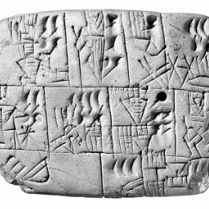
PictureCuneiform (British Museum)
...there was chaos. Things... information... knowledge was scattered everywhere... and no one could find anything they needed... when they needed it. And it was said by someone... although we don't know who... "let there be a semblance of order." And there was a library.

The earliest libraries were housed in the temples of Sumer, a region of city-states in Mesopotamia. They housed:

  • commercial accounts (who sold how many goats to whom and at what price);
  • math and grammar lessons for young scribes (No, my young scribawan, the correct usage is I couldn't care less, not I could care less);
  • medical and astrological treatises; and
  • collections of hymns, prayers and incantations.
All of these were recorded on clay tablets in a form of writing called cuneiform. And no doubt, Marian the Sumerian Librarian kept those stacks of tablets neatly edged and in perfect order. Of course, back in the day, this was easy to do because the stacks (as such) were closed, meaning that they and the material they held were only accessible by library staff (in this case, the temple scribes).

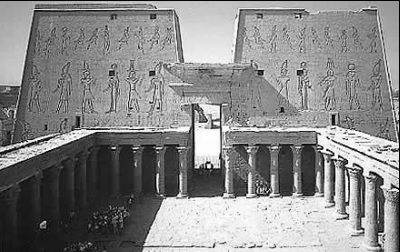
PictureTemple at Edfu (Ancient-Egypt.org)
And someone said... although we don't know who... "go forth and multiply... gather up all the information and knowledge and have dominion over it... sort it... and organize it... and make sense of it... so that you might make it available for mankind so that knowledge may grow from more to more and therefore human life be enriched." And so the idea of libraries spread and grew, from the Egyptian "House of Papyrus" at Edfu (I kid you not!) to the fabulous scholarly collections of Ashurbanipal and Alexandria and the Ottoman Empire to the imperial libraries of Constantinople and Damascus to the monastic libraries of the Middle Ages to the libraries of the great universities at Oxford and Paris to the earliest "public" libraries in Europe and the United States.

If it's a temple, then I must be a Goddess...
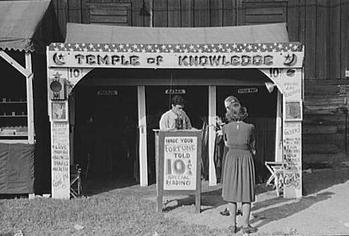
Picture(courtesy ancestry.com)
But even as libraries spread and developed and evolved, the notion of "library as temple" remained. It was a Temple of Knowledge of which the Librarian was a Guardian Goddess who sat at the Altar of Reference. The patron/supplicant would approach the altar seeking succor in the form of information (a tablet in Mesopotamia, a book elsewhere, once the "miracle of Mainz" occurred) Because in these early libraries, the emphasis was much more on storage and preservation rather than use. Hence, books were often chained to tables to prevent their removal by sticky-fingered patrons or kept behind bars (literally and figuratively) and only handed over reluctantly for brief periods of perusal within the confines of the temple/library.
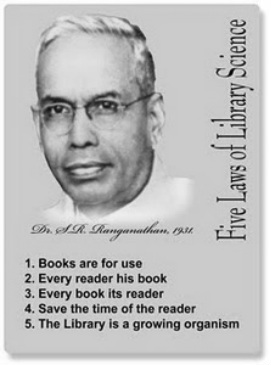
PictureRanganathan and his laws
And then someone said... "Books are for use." (We actually know who said this, the rock star/ library god, S.R. Ranganathan, who didn't carry his 5 Rules down from Mount Sinai engraved on a tablet, but he still became one of the most influential philosophical figures in the history of librarianship. He also didn't conclude his pronouncement with the interjection, "Duh!") He also said that every book has its reader and every reader has his/her book.  Now these truths may seem self-evident, but it wasn't always so.

So, over time and with the brilliant innovations of a few smart librarians following the Laws of Ranganathan and the organizational system of Melvil Dewey (or Library of Congress, if you're in academia) and bolstered by the monetary input of at least one capitalist with a thirst for knowledge and a taste for philanthropy of the intellectual kind, the idea of a library has evolved into being more of a market place. And the buildings and their accouterments changed to reflect that notion. Andrew Carnegie (btw, that's Car-NEG-ie, not CAR-ne-gie), who provided millions to build public libraries in towns across the United States, was also a smart businessman who kept his eyes on his pennies. To reduce operating costs in the branch libraries in his native Pittsburgh, his directors introduced the "open stack" policy, a revolutionary idea of "self-service" in which patrons could access books directly, without having to approach the Reference Altar. John Cotton Dana pursued this same policy in the Denver Public library and other systems that he administered.

Books had become far more plentiful and easier to replace; the cataloging systems were easy to use and made locating material much more straightforward for the average person. Entering the stacks was no longer like entering the Holy Sanctuary, it was like entering Books R Us or Infomart.


Would you like some Nietzsche with your Kierkegaard?
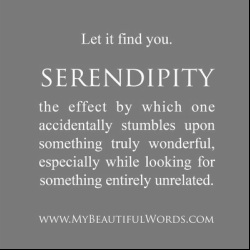
Picture
Hence the idea of library as marketplace: librarians, instead of reclining at the altar, go out and drum up business and patrons get to browse and touch the goods before committing to a purchase.

Which, of course, led to exploration and the birth of Serendipity, who, unlike Venus, did not rise up out of the ocean on a clam shell wearing only her hair. (Serendipity the word was coined by Horace Walpole in 1754 and means "a fortunate happenstance" or "a pleasant surprise.") Indeed, it (or she, or he, however way you roll), as a library experience, blossomed in the midst of the freedom that patrons had to, in the words of Ranganathan, "wander among the books and lay his (or her) hands on any of them at his will and pleasure." Accompanied by Serendipity, in the course of looking for one book, a patron may find, just by chance, another even more suited to his (or her) liking. Or perhaps even two or three or an armful...
 Because you can't always know what you want, much less get it, unless you can take a look around. (And yes, I know that with the sophistication of our online PAC systems, you can "virtually" wander a shelf, but it's not quite the same thing, now, is it? And don't call me a Luddite. I love technology, I am comfortable with it, I teach it, I respect it, blah, blah, blah...)

Serendipity deepens the joy of using a library (there's one of those feeling words again) for patrons of all ages, from the pre-schooler stumbling upon Ruby and Max, those irrepressible bunnies created by Rosemary Wells, while on the hunt for the latest Pigeon book by Mo Willems to the tween who finds the fantasies of Emily Rodda while picking out the sequel to Rick Riordan's The Lightning Thief to the adult who might walk into a library looking for Gustave Flaubert's portrait of a bad marriage and went home carrying Gillian Flynn's as well. And it happens all the time in the nonfiction section as well. You stride purposefully down to the 551s section for books about tornadoes, only to have your eyes drawn to the stunning geode on a cover in 540s. And, of course, you just have to stop and peruse. (Or at least I do!)

Marian the robot librarian?
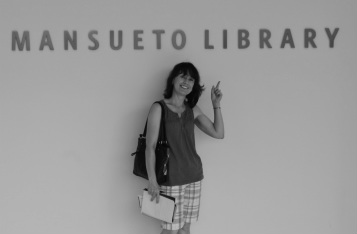
Picture
So, besides being a rather simplistic origin story of libraries, what exactly is this all about?

The Joe and Rika Mansueto Library, the self-proclaimed "library of the future," that's what.

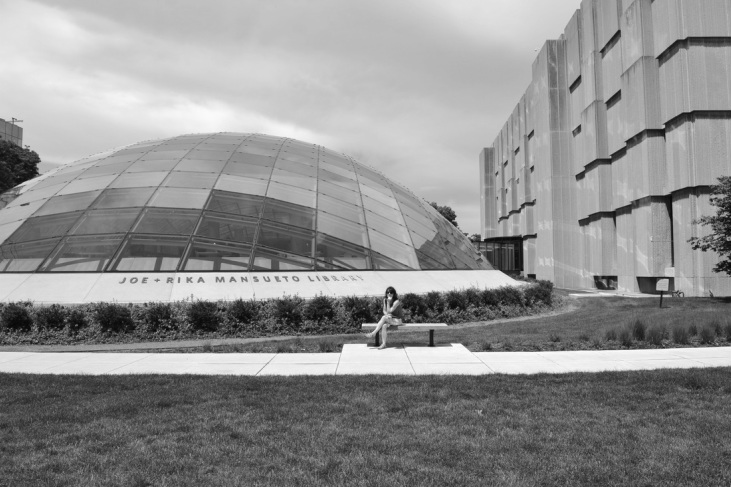
The Mansueto Library, opened in 2011, is the newest library on the University of Chicago campus. It sits just to the west of old Regenstein, like a sparkling, many-faceted, oval-cut diamond tossed down next to a chunk of concrete. The Mansuetos, both alumni, provided a cool $25 million for its construction. Designed by Chicago architectural icon, Helmut Jahn, the library, constructed in the shape of an ellipse, is a stunning physical space and an engineering marvel, consisting of an 8,000 square foot "Grand Reading Room," a state-of-the-art preservation and digitization lab, and an underground Automated Storage and Retrieval System (ASRS) (the "stacks") with the capacity to hold 3.5 million volumes (or volume equivalents, as they put it).
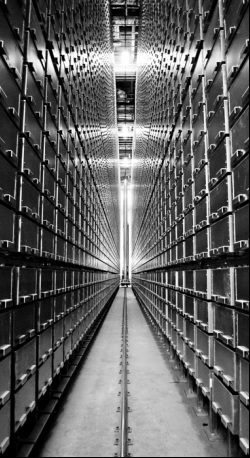
Picture
Rather than shelves, the books are stored in mausoleum-like bins and metal shelf units which are attached to 50-foot-tall storage racks.

Patrons search for and request materials in the library's online catalog. A robotic crane swoops along a track, gathers up the correct bins where the books are located and shoots them up to the main floor circulation desk where patrons can check out the material. The whole process takes about 5 minutes or so. 

A particularly unique feature about the ASRS is that the material is shelved by size, rather than library classification. Poor old Melvil is probably rolling over in his grave, because this is the way books were often stored before he came up with his classification system. Ah, progress...


Picture
The portal...

Under the Dome...

Picture
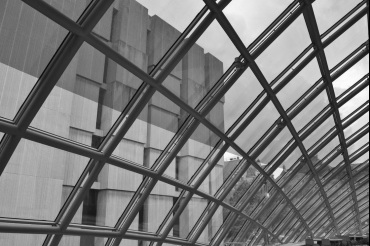
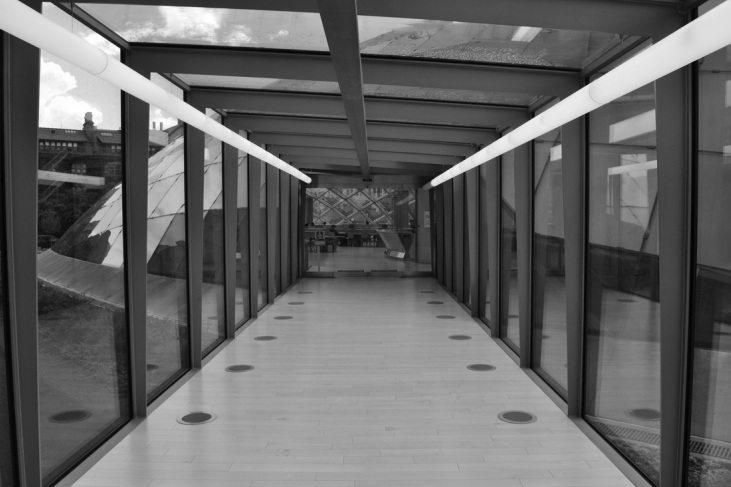
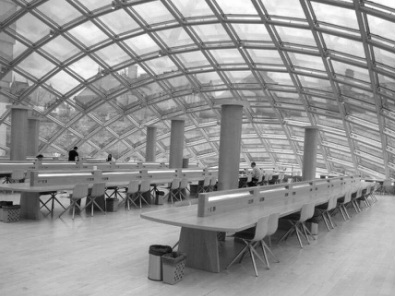
You have to enter the Mansueto through Regenstein for "security reasons." You do so by passing through a connecting steel and glass bridge with sliding doors that exude a Star Trekian vibe. You emerge into The Grand Reading Room, which is very high-end IKEA: yards and yards of blonde white oak, plenty of stainless steel, long tables, shorter tables, all enclosed by an aluminum-framed glass dome.
Picture
The day we visited, the place hummed. Literally. Twice as loud as old Reg ever did. And instead of seeming light-filled and airy, the dome felt oppressive. I felt like I was a firefly trapped under a jar: I could see the enticing natural world (that lovely green grass, those well-tended shrubs)  surrounding me, but I just couldn't get to it, no matter how far I crawled.  (Shades of Stephen King with some Kafka thrown in...) I imagine in the winter, particularly this past winter with its 80 inches of snow, the effect is igloo-like, which might be kind of cool. Until claustrophobia takes hold.

But the worst aspect for me, the library adventuress, was the absolute lack of serendipity in that ultra-modern space. Yes, I understand the rationale.

Preservation
Closed vs. Open Shelving:
A closed automated shelving system allows library materials to be stored at temperature and humidity conditions (60 degrees Fahrenheit and 30% relative humidity) that are ideally suited for their preservation but could not be achieved in open spaces where patrons browse and retrieve materials.


And I appreciate the efficiency. And I understand the "electronic open stacks" of digital image-based texts. Like I said, don't call me a Luddite. That's knee-jerk.

It's just that... as a library wanderer, in a place where "not all those who wander are lost," I feel the loss of serendipity.

Closed stacks = no wandering. No wandering = a limit on the possibility of every book finding its reader and every reader finding her book.

That seems kind of like ancient history to me.
Picture
Contemplating whether to scale the dome, as others have apparently done (perhaps U of C will be adding shrubbery with thorns to the landscaping)

There's always another adventure waiting on a higher shelf...

Well, it's not a music video...but it's kind cool to get to go behind the scenes.

2 Comments

The Way You Make Me Feel

7/26/2014

2 Comments

 
PictureNot Harry Potter's Order of the Phoenix
"They may forget what you said -- but they will never forget how you made them feel." -- Carl W. Buehner

This quote has often been attributed to Mara Angelou, but according to Quote Investigator that's not supported by factual evidence, although it certainly feels like something she would say.

Regardless of who first said it or wrote it, I think it applies to libraries as well as people. Our sense of a library as a place—welcoming or not—our sense of a library as an entity—benevolent, embracing, dynamic—makes all the difference in the world as to whether we decide to spend any of our increasingly precious time on Earth in that place. We can talk about circulation statistics and the sheer number of things: volumes in the catalog and e-book downloads and reference requests and library cards issued and meeting rooms booked and programs sponsored and computers with Internet access and maker spaces, but I believe that it's how a patron feels when he or she is inside the library that will determine how often that patron will return.

Classic example: me and Regenstein Library (my loathing of which I detailed in an earlier post).

I freely admit that I have a love/hate relationship with the University of Chicago. I love to hate it and I hate to love anything about it.
 
(Internal argument rages:
Better angel: Oops, that just slipped out. Maybe I should delete it?


Less-than-better angel aka lil' devil: No, let it stand, let those feelings out! After all, they won't be asking you to give a book talk on that campus any time soon...)

There is, uhhmm, was my fondness for Harper Memorial Library, but now that's so over... I guess it's just some library that I used to know...

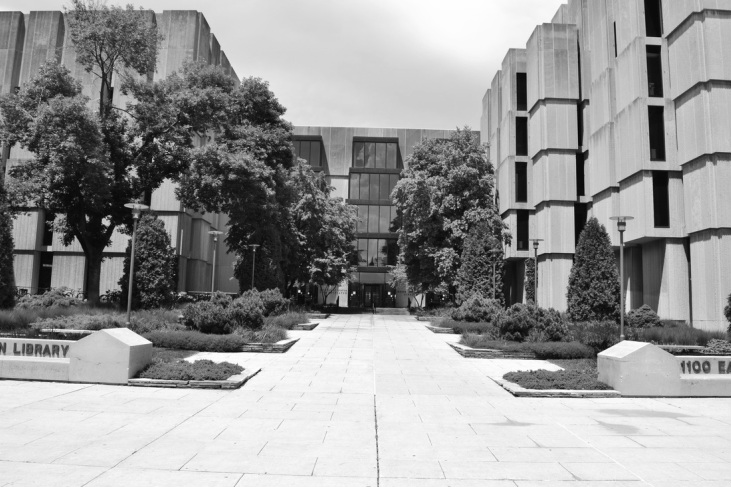
On my recent visit to the storied campus in Hyde Park, besides being confronted by the atrocities committed at the library formerly known as Harper (Prince-like symbol to follow), I also felt compelled to take a stroll across the quad to once more face my bête noire, Regenstein Library.

Face to face with the beast

It was one of the few hot and muggy days we've had this summer in the Chicago area. One of those days that brew drenching thunderstorms out of unstable air masses and sure enough, the low-hanging gray clouds let loose just as we passed Botany Pond so we dashed for shelter under Cobb Gate.
Picture
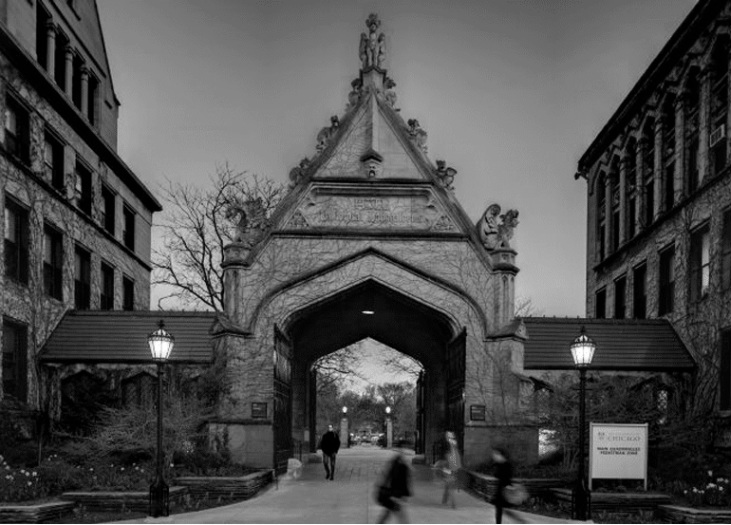
Cobb Gate - gotta love the gargoyles
We waited for the deluge to subside with two campus tour groups consisting of a U of C guide, prospective students and their parents. The guides, a male and a female, were both relentlessly perky (no, there is no other word to describe them). The high school kids somehow managed to look simultaneously eager and blasé. The parents were either the Black Hawk helicopter types who ask all the questions while their offspring shrank back in the crowd pretending not to know them or the deer-in-the-headlights, resigned-to-their-fate types. You know, the kind of parents who wear T-shirts that read "My son/daughter and my money go to..."ed
All the while, I stared in dread to the north where, across 57th Street, the hulking brute squatted, waiting. When the rain had diminished to a fine drizzle and the perkiness of the tour guides had begun to shred the nerves, we made another short dash across the street and up the long, sloping walkway to the library's entrance.

And then we were inside the beast.

Picture
The entrance to seven of Dante's Nine Circles of Hell
And all of a sudden I heard the voice of the immortal Peggy Lee warbling inside my head.
And she's not singing "Fever."

"Is that all there is?
Is that all there is?

If that's all there is my friends...."

And it has books (what a concept)...

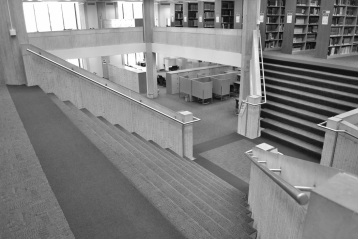
PictureRegenstein interior (this is a color photograph)
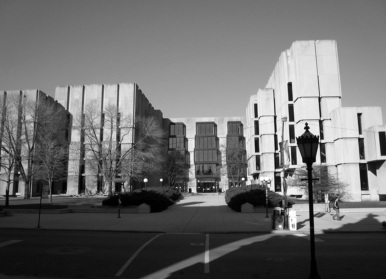
Really. It's not a monster. It's just a library. A very large library. With over 4.5 million volumes spread across seven floors and over 570,000 square feet, employing 33 subject specialist librarians, focusing on the humanities and social sciences, with a bit of business and divinity thrown in for good measure.

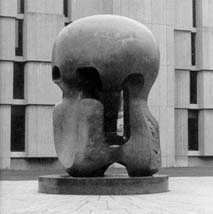
Old Joe Regenstein was a life-long resident of the city of Chicago and a major industrialist who made his fortunes in the paper, plastic and chemical fields. After his death in 1957, his foundation donated $10,000,000 toward a new graduate research library.  After the groundbreaking in 1967, the library was completed and dedicated in 1970. The library actually was built on the site of the original Stagg Field, the University's athletic field from 1892 to 1967. It's also the spot where Enrico Fermi and his Big Bang Theory type buddies achieved man's first controlled, self-sustaining, nuclear chain reaction on December 2, 1942. Whence sprang the atomic bomb and the Oppenheimer quote... "I am become Death... the destroyer of worlds." And to think it all began in a squash court. (There's a classic bronze Henry Moore sculpture called—what else?—"Nuclear Energy" plunked down on the western edge of the 12-acre site. Depending on your angle of viewing, it resembles a mushroom cloud or a misshapen skull, both of which are totally apropos.)

But some things never change...

PictureHenry Moore, Nuclear Energy
Hmmm, maybe that's why the whole freaking place just... hums. 

Yes, the fluorescent lights still drone with an annoying vibrato (perhaps like an irradiated mosquito would sound) and the HVAC system still permeates the silence with  its heavy breathing, like a pervert on the other end of the phone line. And all that limestone fashioned to look like concrete is still a vast stretch of one shade of gray (if it was a Crayon it would be called "Depression"). And even the carpet seems like a hard surface.

But on this day... on this day something seemed... different. It felt... different. I felt... different.

Interior monologue:

Oh wait, I'm not a student there anymore...with the weight of all that entails pressing down on my head and my shoulders. No wonder I feel so... light... so free!

I'm just visiting!


And that makes all the difference in the world.

Buzzed... in a good way

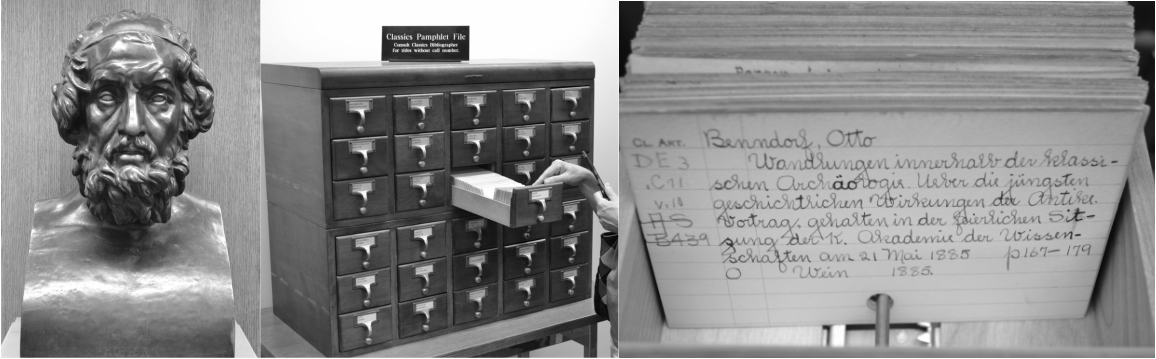
So instead of picking up my backpack and trudging out after a half an hour of the ever-present buzzing—really, I swear, it's not just all in my head!—we headed upstairs (traipsing all the way) to the 4th level of hel--oops--the 4th floor where the Classics Reading Room Collection is located. This room contains both a bust of Homer (with a well-rubbed nose) and an old-school card catalog (with actual cards inside, some hand-written.) And, feeling totally giddy, we just had to document this (and our feeling of giddiness, a completely foreign emotion in this place).
Picture
In the Classics Reading Room with a Greek poet, looking up a Latin text on a card handwritten in German.
Then, feeling even more adventurous, we headed into the stacks, where we thought we heard a cricket chirping. A cricket in the stacks?!?! Life, proof of life, in the midst of that man-made monstrosity. We followed the sound, feeling like spies, weaving through the shelving units, until we came to its source.

Alas, just a HVAC fan in desperate need of some WD-40.

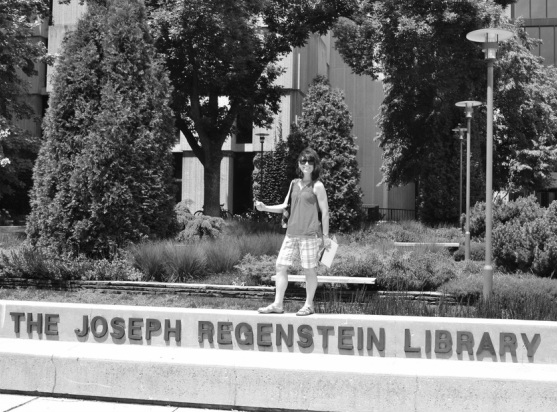
Picture
Conquering the beast (and feeling "radioactive")
Okay, enough fun and games. It was time to head next door to the Joe and Rika Mansueto Library, the self-described "library of the future."

But that's a topic for another blog post because...

There's always another adventure waiting on a higher shelf...

I believe the term "batshit crazy" applies here...

2 Comments

Roll over, Bill Rainey and tell Regenstein the news

7/17/2014

2 Comments

 
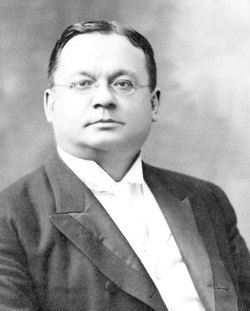
PictureThe man (courtesy U of C archives)
An open letter to William Rainey Harper:

Dear Mr. Harper:

This letter is to inform you that you are dead. As in "stone-dead; ...as a doornail; ...as a herring; ...as mutton; stiff." Sorry, got carried away again with the Roget's. Back to the point. Yes, I know as well as you do that the physical vessel which held your prodigious intellect and passion for education (also known as your body) actually expired in 1906, and thus you have been officially deceased for over one hundred years. But your spirit, dear sir, has always lived on at that magnificent institution of which you were a founding father... the University of Chicago.

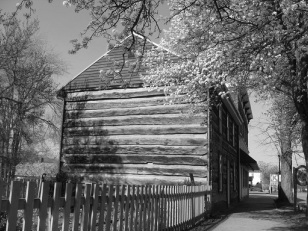
I need not remind you of your humble beginnings out of which sprang numerous and illustrious accomplishments in the world of academia. You may not have been the first man born in a log cabin to rise to a presidency, but you were the only one for whom Greek, Latin, Sanskrit, Hebrew, Aramaic, Arabic,
Syriac and Akkadian rolled trippingly off the tongue.

The genius of you...

PictureHis humble origins (Nat. Reg. Hist. Places)
You earned a PhD from Yale at the tender age of 18; you held teaching positions and professorships at Masonic College, Dennison University, Baptist Union Theological Seminary and Yale. You taught through the venerable Chautauqua Institution. And let us not forget your musical talents tinkling the ivories and leading the New Concord (Ohio) Silver Cornet Band!

However, the pinnacle of your success has to be the establishment of the university and its stunning, Gothic-inspired campus in Hyde Park on the south side of Chicago. Yes, YOU were the FIRST president of the great gray city that would soon come to be known as the "Harvard of the Midwest." (Oh, don't be offended. We who attended your fine institution as undergrads, and slogged through its rigorous curriculum (the ORIGINAL "Common Core") of humanities, mathematics, social studies and science, always referred to Harvard (and still do) as the "U of C of the East." (And the two schools are certainly NOT to be confused with Dorothy's Wicked Witches of the East and West, even though both have, at certain and sundry times, engaged in practices that one might consider, if not evil, then at least unethical, questionable and/or shady. For instance, there was that time the U of C awarded its first Albert Pick Jr. Award for Outstanding Contribution to International Understanding to Robert McNamara, Defense Secretary during the Kennedy and Johnson administrations, who just happened to be the architect of the Vietnam War. (Read the original Pick Papers here.) Oh what a tempest in a teapot that decision engendered! Students actually protesting... on campus! What a concept!

I mean, let's face it. The major "understanding" that whole fiasco promoted was that one should "never get involved in a land war in Asia" (props to Vizzini and William Goldman).

Spires, gargoyles and wild onions: the nexus

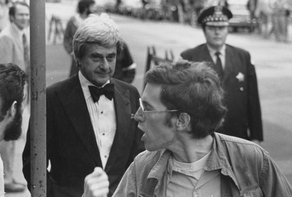
Picture1979 demonstration (U of C archive)
But, as is often the case with us 21st Century writers, I totally digress in my lyrical musings. Far afield. Back to the matter of your life and death...

So, yes, you built this incredible institution of research and scholarship from the ground up, raising a main quadrangle that brought the English Gothic spires of Oxford University to the shores of Lake Michigan, from which lofty heights the gargoyles could look down upon the land that, in the not-so-distant past, had been swamp marshes that stank of foul-smelling wild onions. (Some of which, by the way, still grow in the area on open land and in forest preserves.) In your spare time, you also helped found Bradley University in Peoria, Illinois. A man of such talents is often honored by the naming of things, usually buildings and streets. So it should come as no surprise to you that William Rainey Harper College in Palatine bears your name, as well as Harper High School in the West Englewood neighborhood and Harper Avenue in Hyde Park.

But of course, the most glorious and apropos monument to your illustrious self is William Rainey Harper Memorial Library located on -- where else? -- the campus of the University of Chicago.

A cathedral of knowledge...

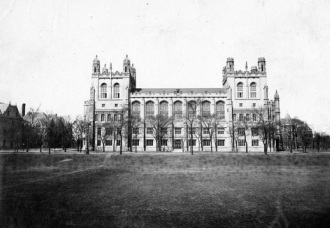
PictureHis monument (U of C archives)
And that is where I sadly -- nay -- shockingly learned of your absolute and total death one recent Saturday morning. Yes, turn over in your grave now, just once, for soon you will be spinning, as if your casket were a centrifuge.

After your untimely physical death in 1906, the university was inspired to erect a permanent memorial to you. And what could possibly be more appropriate to honor a man of your wide-ranging scholarship than a library. The Chicago Tribune noted in 1907 that it would be "a fitting testimony to one of Chicago's most useful citizens." (Italics mine. And Bill -- may I call you Bill? -- don't be affronted by being damned by faint praise, it happens to everyone!)

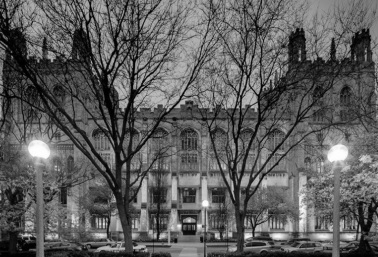
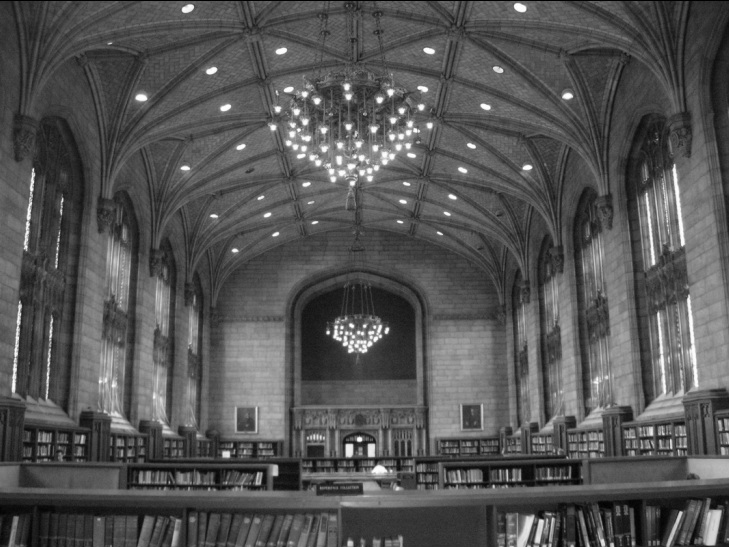
Finished in 1912, the building's façade is emblazoned with stone carvings of the coats of arms of Oxford, Cambridge, Harvard, Yale, Stanford and the University of California, among others. Its two towers are fraternal twins, similar but unique. The East has Byzantine domes that echo the great Orthodox basilicas of Europe. The West brandishes the battlements of a Renaissance castle. The interior of its third floor library aspires to the heavens with its vaulted ceiling and celebrates the life of the mind with its carved printer's marks and mythological symbols.

It is a library to truly inspire... awe. (I shall refrain from employing the overused late 20th Century term which contains the root word "awe" although this is one instance where that word would certainly be used appropriately.)

May I be intimate for a moment, Bill, and reveal my soul to you? As a freshman, I was simply blown away -- pardon the colloquialism -- upon entering your memorial. Every time. I mean EVERY time. As a little girl who grew up barely a stone's throw away from what can be kindly referred to as the "industrial armpit" of the city of Chicago, I realized that by walking into your library, knowing I was a student at your university, I had truly achieved something, and been truly transported somewhere. As I said, it is a library to inspire....

And they're complaining the TRUMP sign looks tacky?

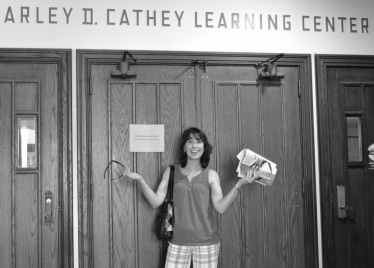
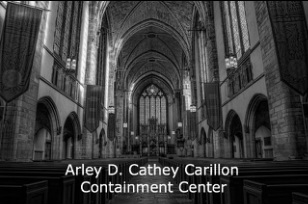
PictureWTF???!!!?? Arley who? Even the sign looks cheap!
Well, Billy, baby, I need to correct that last sentence. It was a library to inspire...

Now --- and I am mortified to have to be the one to tell you this --- now it is a.... a... reading room. In fact, it no longer even carries your hallowed name. It's officially called the...

 Arley D. Cathey Learning Center.

NO, no, no, no, no, no, no, nooooooo---ooo---ooo---o--o-o-o-o-o-o-!

Bill, sweetie, you and I both know how WRONG, WRONG, WRONG that is!  A "learning center" is what you find in an elementary school, not a world-class institution of higher learning. (Or has U of C totally started to infantilize its undergrads?)

And even in an elementary school, a "learning center" functions as a library. Because it has BOOKS! Books to read and to check out at a circulation desk...

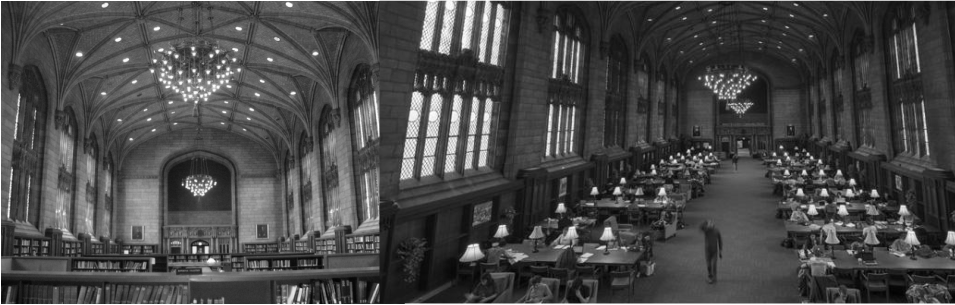
Oh, I weep... at one time, Harper Library and the adjoining departmental libraries held 2 million volumes... now, nary a one... except for those that the students carry in... presumably to... read.


Picture
Before: Harper Memorial Library (with books) ---- After: Cathey Learning Center (tables, chairs, no books)
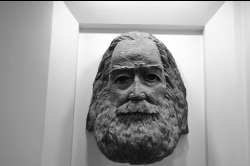
PictureEven Walt Whitman is speechless.
Yes, yes, I know it still boasts the vaulted ceiling and the chandeliers... it's beautiful and always will be... but this is about more than aesthetics, about more than skin deep... there's something vital that's missing. And that wonderful smell is gone, too. That scent that hung in the air... the tang of knowledge, with undertones of curiosity and speculation and the weight of wisdom... that smell peculiar to old books.

Harper was the small library, the quiet library, the undergraduate hangout, the peaceful place compared to hulking Regenstein across campus. And, Billy, I guess the intent was to preserve this atmosphere... at least according to the perpetrators of this crime. After all, "lighting, heating, and air conditioning" are essentials in the 21st Century... for students who are total wusses...

Oh forgive me, Billy, my snark runneth over... but you were sold out for $17 million. Butane Gas... who knew? Apparently, that sum also purchased the bragging, errr, naming rights to a residence hall and dining center...

Picture
"And I'm never goin' back to my old school..."
PictureArley D. Cathey Naming Things (Tumblr)
But, Bill darling, take heart. Apparently, I'm not the only one who has issues with this atrocity.

There's a Tumblr (it's a blog site, dearie) dedicated to lampooning this 21st Century practice for those who have the money to throw around. (You  called them tycoons and philanthropists and I'll remind you that Rockefeller gave big bucks to found the U of C and vociferously insisted that it NOT be named after him! We call them the 1% and everything seems to sport their monikers.) But to think they would sink to this... to think they would treat your memorial like some random football stadium or sporting arena!

Oh sweet, sweet Bill, I just don't know what to say...

Yours ever in library love,
Jo

Of course, the next thought in my mind was... I wonder what they've done to Regenstein?

But that's a query for another blog post because...

There's always another adventure waiting on a higher shelf...

Check out the absolutely fabulous back-up singers!

2 Comments

The College Years: A Tale of Two Libraries

7/8/2014

1 Comment

 
Libraries are the hot, burning center of any educational universe. Or they should be. Student life in elementary school should include joyous trips to the library media center (or whatever it's called at each particular school --- you name it, I've heard it: LRC (Learning Resource Center), LMC (Library Media Center), IRC (Instructional Resource Center), LLC (Library Learning Center). See what word all those appellations have in common? Yep, that's right: center with a capital "C," mind you, and that rhymes with "e" and that stands for... you get the picture.
Picture
Now granted, middle schoolers and high school students may not celebrate trips to the school library with as much enthusiasm as the wee ones, but still, they generally have a sense that it's a place to chill, eat lunch far from the madding crowd (if they have a cool librarian), Google some trivia (if they are smartphone-less), catch a quick nap (if the chairs are comfy -- or even if they're not) and generally just "be."

And by the time students get to college, the library, even more so than their dorm rooms, becomes their home away from home. (Well, at least that's what their parents hope!)

Crescat scientia; vita excolatur

The above roughly (or smoothly) translates as “Let knowledge grow from more to more; and so be human life enriched.”  It is the motto of the University of Chicago, my alma mater (though how kind and nourishing this mother was is questionable... but that's a topic for a different blog).

Considering I was the girl who wanted to go places, I didn't go too far, just to Hyde Park, still on the south side of Chicago, the location of said university. My time there was a tale of two libraries...

(William Rainey) Harper Library

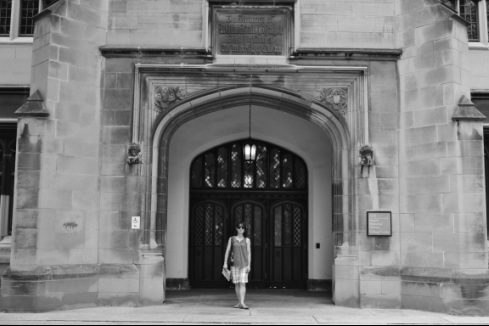
PictureHarper Library exterior (in the gray of winter)
Ahhhh...

it was the best of times, the age of wisdom, the epoch of belief, the season of light and the spring of hope...

this was not just a library...

more a cathedral of knowledge, from its Gothic spires to its arched stained glass windows.

I could barely resist the urge to genuflect every time I passed through its heavy oak doors.

And then there were the gargoyles....

Truly badass gargoyles!

Oh, it had books, too. And a wonderful old smell and weight to the air inside, as if it held all the knowledge and wisdom of centuries past that scholars had struggled to bring forth with sweat and tears and migraine headaches and just taking in a deep breath would convey all that inside of me.

I didn't have to close my eyes to imagine I was somewhere else. I WAS somewhere else... a place of elegance and refinement...

And a place where EVERYONE was different... not just me.

Picture
Harper Cathedral, oops --- Harper Library interior

(Joseph) Regenstein Library

PictureRegenstein exterior (early spring - maybe)
And then there was the other one...

the worst of times, the age of foolishness, the epoch of incredulity, the season of darkness and the winter of despair... Regenstein.

In my mind, it is no coincidence that Regenstein rhymes (sort of...) with Frankenstein. The place was a man-made monster that choked the life out of me. There were no deep breaths to take in Regenstein...

Literally...

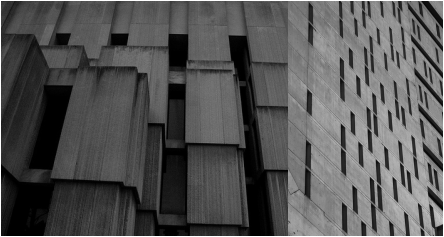
I couldn't breath under the oppressive glare and constant hum of its fluorescent lights and ventilation system. I didn't care if it was constructed of grooved limestone. I t had the look of plug-ugly cement. I didn't care if the façade marginally resembled the fore edges of books (the sides opposite the spines). Half an hour in its cold sterile embrace and I'd be scuttling for the doors, like the cockroaches in the basement of Woodward Hall when startled by the sudden flick of a light switch.

PictureLibrary... or prison?
Luckily, unlike those locked up in the facility on the right in the image below, I was free to leave.

But the worst thing about Regenstein?


NO GARGOYLES!!!!!


I really did go looking for some piano music...

But I must confess, there is one good memory I have of an adventure in that library. I remember kissing a slender blonde boy in the stacks where the music scores were stored. No one went in there. After all, U of C was the place where fun went to die. No one had time to practice his or her instrument... or those students who were musically inclined were so incredibly bright and talented that they had every single note of every piece of music they could possibly care to play already memorized. Or so we thought.

It was a little awkward at first because he wore glasses, so he finally took them off and then forgot them on the shelf. (Did he wind up as an absent-minded professor?) Later, when we went back to retrieve them, they were GONE! To this day, I have no idea if someone else, a saxophone player, perhaps, was in there with us, sharing our little adventure. This was, of course, back in the day, before the dawn of the ubiquitous security camera. Young lovers beware!

Picture
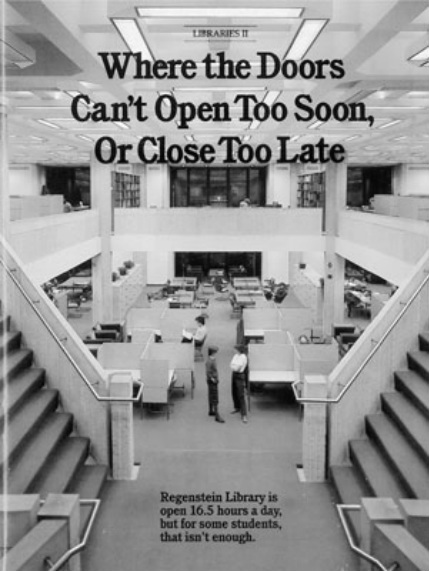
Regenstein interior --- Oh yes, they can! (UC archive image)
Unlike Sydney Carton in A Tale of Two Cities, I survived my tale of two libraries and recently returned to my old haunts to see how the years have treated them....

but that's a tale for another post...

There's always another adventure waiting on a higher shelf...

1 Comment

    Author

    Joanne Zienty is, in no particular order, a reader, a writer, a teacher and a librarian who resides in the western suburbs of Chicago. She's been a library aficionado since early childhood.

    She was recently named the winner of the first Soon to be Famous Illinois Author Project sponsored by RAILS (Reaching Across Illinois Library System) and the Illinois Library Association.

    Archives

    June 2017
    August 2015
    June 2015
    January 2015
    October 2014
    September 2014
    August 2014
    July 2014
    June 2014

    Categories

    All
    2014
    2015
    2017
    Arley D. Cathey
    Art In Libraries
    Carnegie Library
    Chicago
    College
    Comics
    CPL
    Feelings
    Harper
    Haunted Libraries
    History
    Learning Centers
    Librarians
    Libraries
    Library Serendipity
    Mansueto Library
    Reading
    Referendums
    Regenstein
    South Chicago
    Sugar Grove
    Superheroes
    University Of Chicago

    RSS Feed

©2024 Joanne E. Zienty

Proudly powered by Weebly